Three Shifts Every Pastor Should Understand Right Now
The current cultural landscape is undergoing three simultaneous shifts, offering the Church a unique, strategic opportunity to meet a growing public hunger for authentic community.


Something is happening in the culture, and most church leaders we talk to can feel it, even if they can't quite name it.
Attendance patterns are changing. The people walking through your doors are asking different questions than they were ten years ago. The tools and strategies that worked a decade ago are producing different results today, and underneath it all is a sense that the ground itself has shifted.
We believe it has, and we believe understanding why is one of the most important things a church leader can do right now.
Why This Moment Feels Different
At Gloo, we spend every day working alongside churches, ministries, and organizations that are committed to serving. We see the trends and the real challenges ministry leaders are navigating on the ground. And what we keep seeing, across congregation sizes, denominations, and geographies, is the same thing: leaders standing in a moment that is genuinely unlike the one they were trained to lead in.
That's not a reason for alarm. But it is a reason to pay attention.
Which is why, when Ben Elmore, CEO of Servant, a digital consultancy serving the faith & flourishing ecosystem, shared his new framework for understanding this moment, we knew it was something every pastor and ministry leader needed to read.
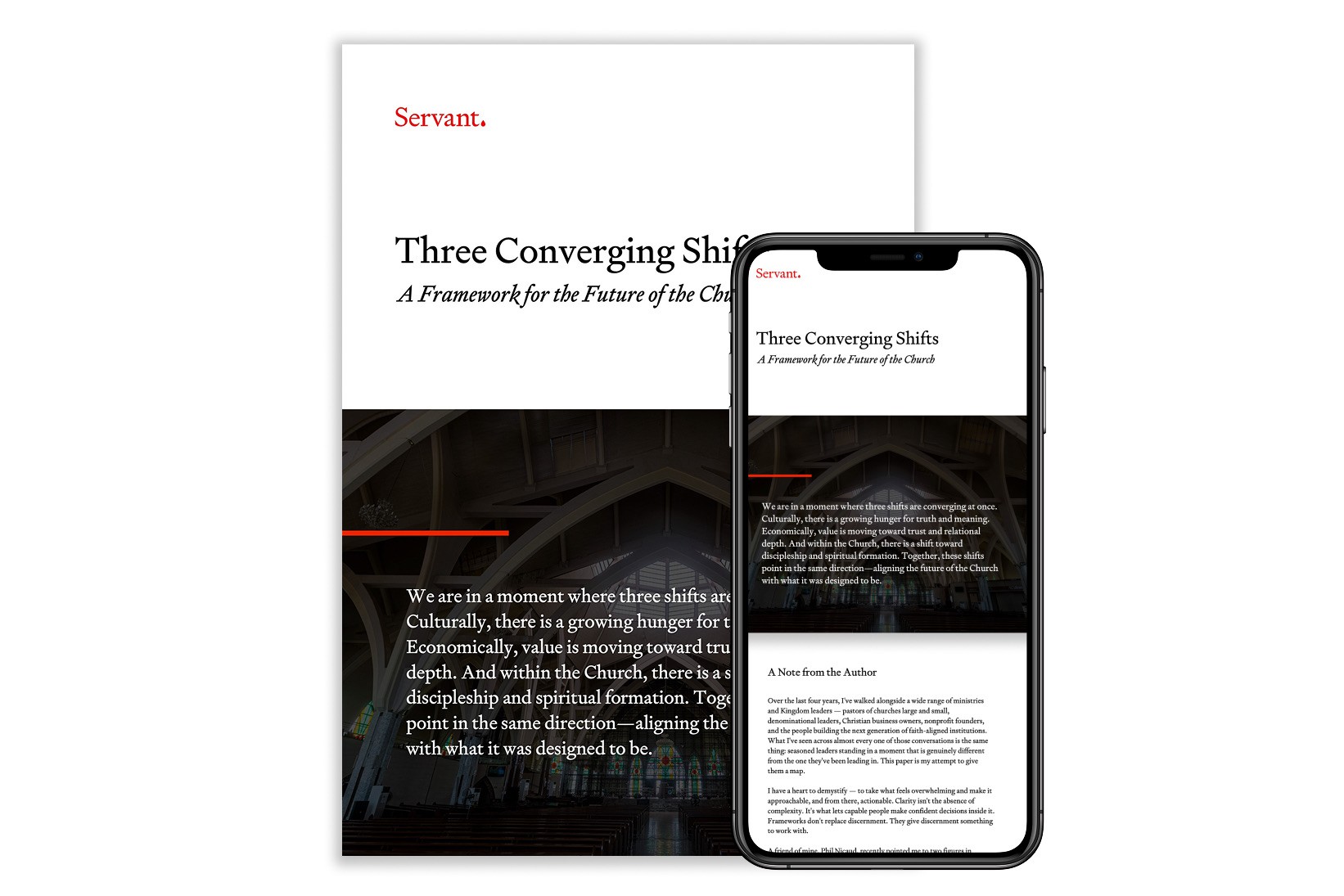
His white paper, Three Converging Shifts: A Framework for the Future of the Church, maps out three simultaneous changes reshaping the Church's landscape. These changes are not threats but can be leveraged as opportunities if you know how to see them.
The Three Shifts
The Sociological Shift: Culture is hungry for what the Church offers.
The postmodern experiment — build your own truth, construct your own meaning — is failing. Depression and anxiety have reached crisis levels, particularly among young adults. What's emerging in its place is a genuine hunger for truth, community, and meaning that is earned rather than constructed. Researchers call it metamodernism. Pastors might simply call it an open door.
The people your church is trying to reach are not hostile to faith. State of the Church research from Barna and Gloo found that Americans' belief in Jesus has reached decade-high levels — up 12 points since 2021, driven largely by young adults and people with no prior faith background. The people your church is trying to reach are not moving away from faith. Many of them are moving toward it for the first time.
Many of them are exhausted by the alternative. They are looking for exactly what a healthy church provides: a community of trust where meaning is made together.
The Economic Shift: The world is learning to value what the Church already has.
Every major institution in business and culture is scrambling to build collaborative networks, interlocking partnerships built on shared mission and mutual trust. They are investing enormous resources trying to construct something the Church has operated on for two thousand years.
Covenant relationships. Denominational networks. Parachurch partnerships. The Church's collaborative infrastructure isn't just a spiritual asset. In the emerging economy, it is becoming one of the most strategically valuable things an organization can have.
The Ecclesiological Shift: The Church is being called back to its deepest purpose.
Inside the Church itself, the attractional model, optimized for attendance and the Sunday morning experience, is giving way to something older and deeper. A return to discipleship, spiritual formation, and missional presence in the community rather than programming designed to draw the community in.
According to Barna's 25-year tracking research, the share of practicing Christians in the U.S. declined from 46% to 24% between 2000 and 2025. The formation gap is real. But so is the momentum building among leaders who are ready to close it. This is a moment for a course correction.
Why We're Sharing This
One of our core principles at Gloo is to serve those who serve. Our mission, to build the leading technology platform for the faith and flourishing ecosystem, gives churches, ministries, and the organizations that support them the tools they need to thrive in a digital age.
But technology is only part of what ministry leaders need right now. They also need clarity. They need frameworks that help them understand the moment they're leading in so they can make confident decisions within it.
This white paper from Ben Elmore does exactly that. It takes what can feel overwhelming-- the pace of cultural change, the pressure on the Church, and the uncertainty about what comes next–and makes it navigable. It gives discernment something to work with.
We think it's some of the best thinking available right now on where the Church is headed and why this moment, for all its complexity, is one the Church is uniquely positioned to meet.
Read the Full Framework
We encourage you to go deeper and read the complete white paper, which is available for download directly from Servant. It includes the full research behind each shift, the strategic implications for ministry leaders, and the questions worth bringing to your leadership team.
Last Updated
Download the Full White Paper from Servant
Share on: