Human Flourishing and AI: A New Standard for Ministry Innovation
Innovation in ministry must prioritize human connection over mere efficiency, ensuring that the AI tools adopted by churches genuinely support resilience and growth across every life domain.


Nick Skytland
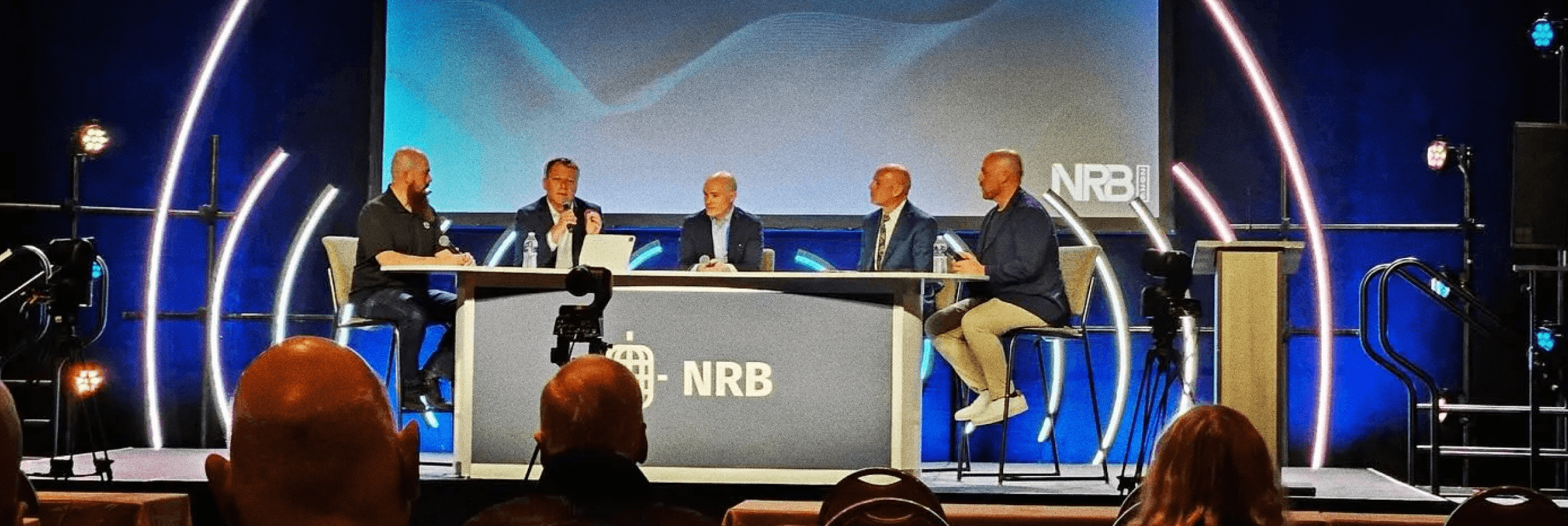
Key Insights from NRB on Trust, Shepherding, and Theological Alignment
At the National Religious Broadcasters convention this week, leaders from research, theology, and technology gathered to address a pressing question: how should the Church evaluate artificial intelligence?
The panel brought together Dr. Byron Johnson of Baylor’s Institute for Studies of Religion, Jonathan Teubner of Harvard’s Human Flourishing Program, John Anderson of Biblica’s Bible Technology team, Nick Skytland, VP of Gloo AI, and Steele Billings, President of Gloo AI.
Together, the conversation made one thing clear. This is not just a technology conversation. It is a formation conversation.
Technology and media do not simply assist us. They shape us over time. If they do not support human flourishing, they will eventually undermine it.
A Holistic Standard for Flourishing
Dr. Johnson grounded the discussion in global research. Flourishing is not happiness alone. It is a holistic state of doing well across domains of life. The flourishing framework asks 109 questions across relationships, physical and mental health, character, finances, meaning, and community. It looks not only at whether parts of life are functioning, but whether the context of a person’s life supports resilience and growth.
One of the most consistent findings across 23 countries is that active religious participation strongly correlates with flourishing. The gap between actively engaged Christians and marginal ones is significant as well. Involvement in a faith community matters; it is one of the most stable predictors of well being.
That lens changes how we evaluate AI.
Most of the industry evaluates models based on capability. Accuracy. Speed. Benchmarks. Reasoning performance. Very little attention is given to how these systems shape meaning, morality, and identity. When frontier models are evaluated through a Christian worldview lens, the results shift. These systems are not typically hostile to faith. They are formationally silent.
Across vendors and architectures, models default to secular and therapeutic reasoning. They avoid strong truth claims. They hesitate to reference Scripture. They provide emotional validation but often avoid moral formation. Even when asked explicitly Christian questions, they tend to treat faith as optional context rather than an organizing framework. They offered broad surveys of perspectives, ethical ambiguity framed as openness, and comfort without direction.
Neutrality is not the same as safety.
This pattern is not a flaw in one product. It is an emergent property of models trained on internet scale data shaped by Western secular norms. These systems carry embedded assumptions about autonomy, authority, and morality. If those assumptions remain invisible, leaders cannot responsibly deploy AI in environments that care about truth and discipleship.
AI is quickly becoming a new authority in people’s lives. It offers personalization without accountability and guidance without shared community. People are asking AI questions that once belonged to pastors, spouses, and mentors. The user may feel heard, but they are not truly known.
As AI shifts from answering to acting through personal agents, the stakes increase. Delegating decisions to systems raises serious questions about responsibility. At what point does convenience erode accountability?
Opportunities and Boundaries
The panel did not frame AI as an enemy. AI creates real opportunity to accelerate Bible translation, expand access to Scripture, and support under-resourced leaders. The Church does not need to retreat. It needs to engage thoughtfully.
Two tensions defined the close of the discussion.
The first was speed versus trust. There is real pressure to move quickly in the current AI race. But trust is built slowly and through faithfulness. The Church will not out-innovate Silicon Valley on speed alone, but it can lead on values. It can insist that AI be safe, accurate, and theologically aligned. It can prioritize trust.
The second tension was scale versus shepherding. AI enables scale. It can extend reach to more people than any ministry could previously serve. At the same time, it must not replace care. For AI to align with human flourishing, it must promote human-to-human connection, not displace it. It is a tool created by people to serve people created in the image of God, and must inherently understand its own limitations.
The panel also raised a deeper generational concern. Flourishing research shows that 18 to 24-year-olds are struggling across multiple domains of life worldwide. At the same time, AI is increasingly mediating how people experience relationships, guidance, and identity.
Social media trained a generation in the attention economy, where platforms compete for focus and time. AI is now pushing further, moving into what some describe as an intimacy economy. These systems are stepping into spaces once shaped primarily by friendship, mentorship, and pastoral care.
When technology begins to mediate not just information but connection, the stakes change. That shift calls for serious theological reflection about formation, authority, and what it means to be truly known.
The Call
This is not optional work. As Christians, there is a moral, ethical, and theological responsibility to shape technology for good and to teach others to do the same. We are not meant to be passive consumers of tools. We are called to influence their direction.
AI must be safe, accurate, and theologically aligned. Human flourishing must become the standard for ministry innovation. Not simply what works. Not simply what scales. But what forms people toward truth, character, community, and faithfulness over time.
Last Updated
Learn more about Flourishing AI
Share on:
Author(s)
Ali Llewellyn
Senior Manager, Gloo AI
Nick Skytland
VP, Gloo Developers


