How Churches are Using AI to Reduce Burnout and Protect Ministry
Many ministry leaders feel perpetually behind, yet strategic use of AI can offload administrative burdens, creating vital space for the pastoral presence that fosters true discipleship.


What I’m Hearing from Pastors about AI, Burnout, and Ministry
Every time I speak to a room of pastors about AI, I ask the same question at the start.
How many of you feel like you’re already behind?
Almost every hand goes up.
Not because pastors are unwilling to adapt, but because many of us already feel stretched beyond capacity. We are already doing the work of three or four people, and the idea of learning one more thing can feel like the last straw on a load that is already too heavy.
This is the reality I keep seeing, and I think the conversation about AI in the church often misses it.
We spend a lot of time asking whether AI is a threat or a tool–whether churches should embrace it or resist it. Those are not bad questions, but they are not the ones most pastors are actually asking. The question I keep hearing is simpler: I am already behind. Where do I even start?
Honestly, I think that is the right place to begin. Not with expertise, but with curiosity, humility, and a willingness to learn.
I have become increasingly convinced that the real AI conversation in the church is not primarily about technology. It is about capacity.
Many Pastors Are Not Burned Out From Lack of Calling
Most pastors I talk to are not questioning their calling. The research confirms what I am seeing across the faith ecosystem. Pastoral confidence in calling has climbed back to 58 percent after collapsing during the pandemic.
But the conditions around ministry have changed significantly. Now, “pastoral vocational satisfaction has fallen from 72% in 2015 to 52% in 2026.” (Barna / Gloo State of Pastors Report, 2026)
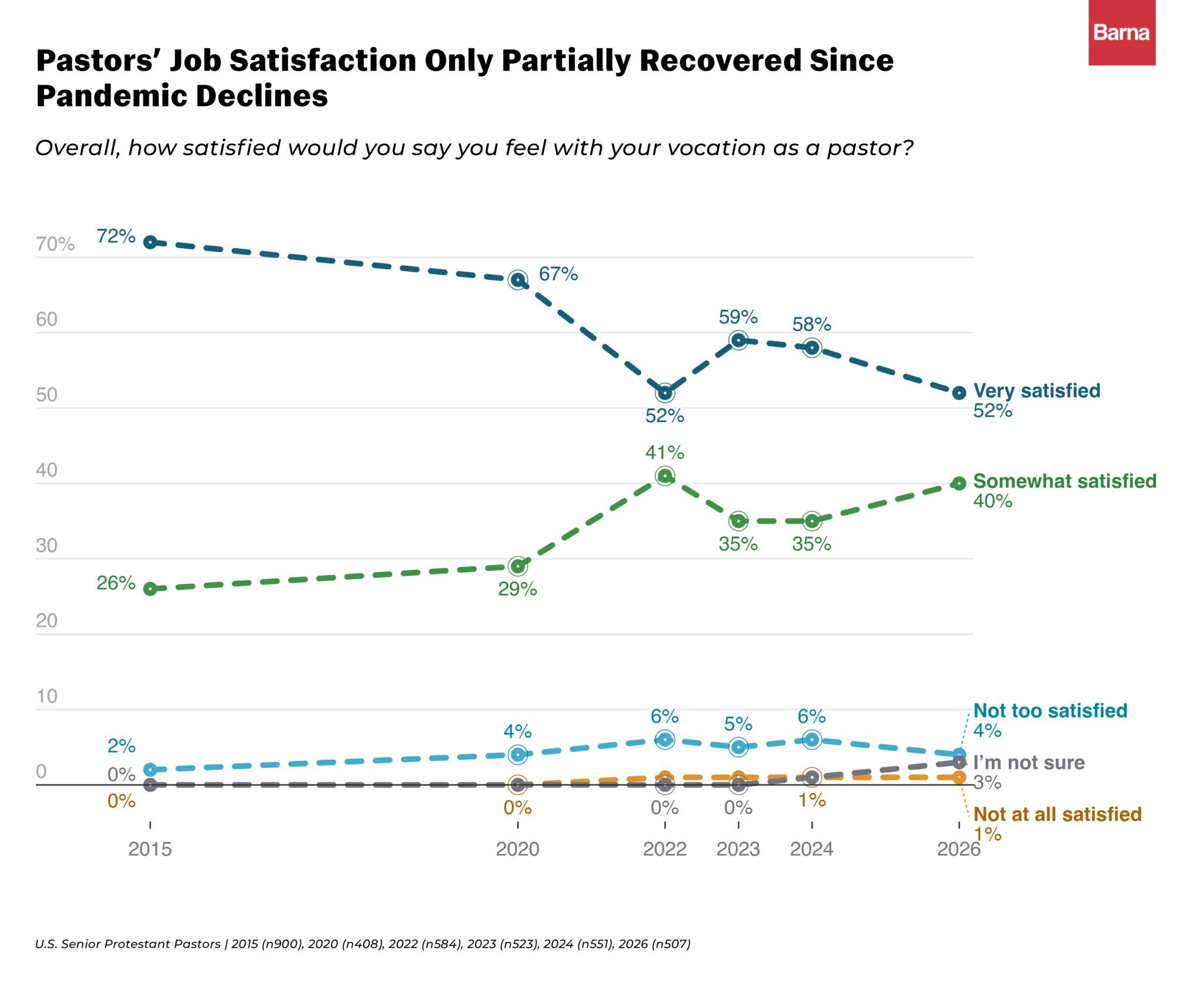
The calling is intact. The structure around it is not. Pope Leo XIV recently wrote in Magnifica Humanitas that AI must never reduce human beings to systems of efficiency alone, but should instead serve human dignity, relationships, and the common good. Honestly, I think pastors are already feeling that tension deeply.
And when Barna asked pastors experiencing burnout what was driving it, the leading answer was not theological doubt or conflict, but misalignment between their responsibilities and their gifts, combined with a limited ability to delegate.
That delegation problem is one of the areas where AI in ministry may actually be helpful.
Research from Carey Nieuwhof shows that 40% of pastors are at high risk of burnout. Many are not burning out because they lack passion for ministry. They are burning out because too much of modern church leadership is consumed by administrative weight instead of pastoral presence.
Email was not part of the calling. HR was not part of the calling. Yet both increasingly shape the daily reality of ministry.
As a bivocational pastor myself, I know this tension personally. It’s not that pastors do not care. It’s that many of us are running at capacity all the time. I see it day after day, pastors who deeply love their people, but who no longer have enough margin left to sustain the kind of presence ministry requires.
Pastors Are Already Using AI in Ministry.
Here is something that does not get talked about enough: pastors are already using AI, and adoption is accelerating quickly.
According to one recent survey, 61% of pastors now use AI weekly or daily–up from 43% just a year earlier. The most common use is sermon preparation. (PR NEWSWIRE)
These are not just tech-forward megachurch pastors. These are church leaders across every size and demographic, trying to find practical ways to keep up with the growing demands of ministry.
From small churches to growing ministry teams, leaders are looking for thoughtful ways to use AI in ministry without losing the relational core of church leadership.
Most pastors I know are not trying to become AI experts. They are simply trying to serve people faithfully in a world that is changing quickly.
The Gap Is Not Information. It Is Margin.
Honestly, the divide I keep seeing is not between pastors who are for AI and pastors who are against it. It is between pastors who have a little breathing room and pastors who are running at maximum capacity all the time.
Pastors with margin can think clearly about new tools, experiment, and integrate them wisely. Pastors without margin cannot afford to get it wrong, so they often do not start.
And when every week already feels overloaded, experimenting with new technology can feel less like an opportunity and more like another demand.
That is not a failure of vision. It is a structural problem. And the irony is that the tools that could help create margin often feel inaccessible to the people who need them most.
This is why I think the conversation has to begin with honesty about the weight pastors are already carrying, not with a list of prompts to try.
What I’m Encouraging Pastors to Remember About AI
The goal of using AI in ministry is not simply to produce more content or move faster. The goal is to protect more space for the work that only pastors and ministry leaders can do. More energy left for prayer, pastoral care, discipleship, and the conversation after service with the person who is not quite ready to say what they came to say.
That work is irreplaceable. And it is difficult to do well when we are depleted.
If a tool can take twenty minutes of mechanical work off your plate and return it as twenty minutes of margin, that matters. Not because twenty minutes changes everything, but because over the course of a week, those moments add up to capacity. And capacity is what makes presence possible.
Healthy ministry has always required healthy rhythms, sustainable leadership, and real human presence. The best church technology should support human flourishing in ministry, not compete with it.
The calling has not changed. The tools are changing. And if we steward them wisely, they may give pastors something many desperately need right now: enough margin to be fully present again.
Over this series, I want to explore a few different ways I think the church should be thinking about AI, not fearfully, but faithfully.
Brianne Shaw is Director of Corporate Marketing at Gloo and a bivocational pastor. She speaks regularly to church leaders on faith, technology, and ministry practice.
Last Updated
Learn how Gloo is applying AI to serve church leaders
Share on:
Author(s)
Brianne Shaw
Director, Corporate Marketing