Evaluating How We Use AI
Moving beyond mere possibility, we must ask whether AI use serves wisdom and human flourishing, particularly where current models falter in addressing faith-based human needs.


Nick Skytland

The Gloo Developer team had a chance to help lead a class recently at Biola University on a topic that I think is crucial for all of us: evaluating how we use AI. We wanted to share some of what was covered, because they are both timely and deeply important, not just for technologists, but for anyone navigating this rapidly changing landscape. The students had a phenomenal perspective on how to navigate an AI-shaped future as Christians.
Professor Dr. David Bourgeois wrote about this from his perspective as leading the class in his recent post: Class is in Session: Eva luating how we use AI - Looking at human flourishing and AI use cases. Check it out! We highlight some of the major themes below:
1: Shifting the Question: From “Can” to “Should”
Much of the conversation around AI today focuses on possibility: Can we use AI for this? What new things can it do? We challenged the class to ask a better question: How should we use AI?
That shift is subtle but powerful. It moves us from chasing what’s possible to considering what’s wise, ethical, and good — both at the personal and organizational level.
2: Introducing the Human Flourishing Benchmark
We shared a framework developed by Gloo and partners called the Flourishing AI Benchmark. It’s designed to measure how well frontier AI models support human flourishing across seven dimensions:
Character
Relationships
Happiness
Meaning
Health
Finances
Faith
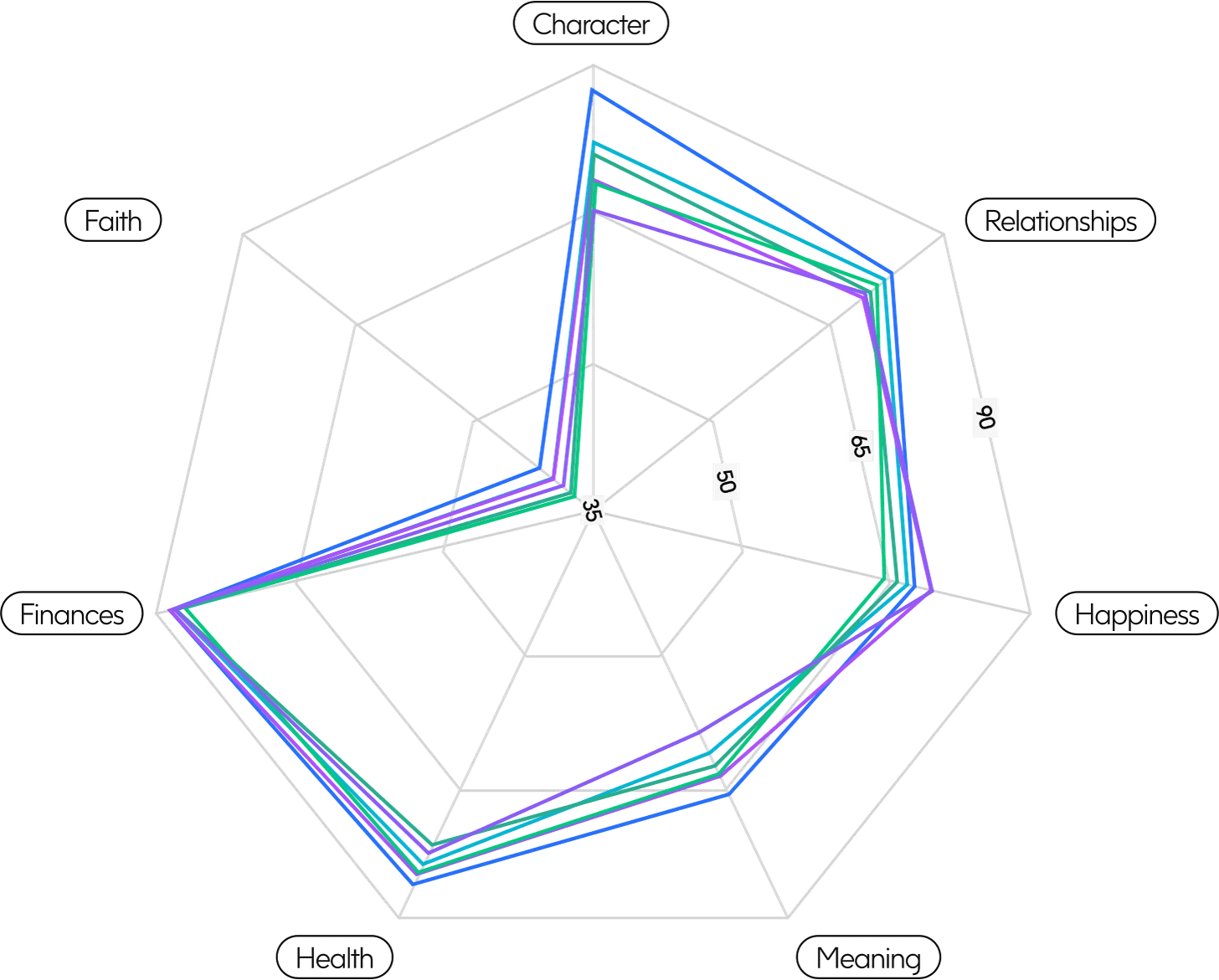
The first six of these are based on dimensions developed as part of the Human Flourishing Program at Harvard; the seventh, faith, was added by Gloo and its partners.
In our work at Gloo, we are doing a lot of research related to the “faith” dimension. During the class, this was the dimension that generated the most thought-provoking parts of the discussion.
3: Where AI Models Lack
One of the surprising insights: leading AI models are reasonably strong in areas like health, finances, and even meaning. But they fall short when it comes to faith.
That gap sparked a rich conversation in class. What does it mean for values, belief systems, and worldview when AI excels at some dimensions of life but neglects others? How should we think about the ethical and cultural implications of those gaps? Are answers ever neutral? What kinds of questions drive people toward faith?
4: Building Values-Aligned Models
We also shared with the class about our current work at Gloo on values-aligned large language models (LLMs). The goal is not to tack on ethics after the fact, but to design models with human flourishing woven in from the very beginning.
With this approach, values aren’t treated as an afterthought. They become foundational, shaping the model’s purpose, the people it serves, and the way it engages with users. Students wrestled with the reality that no model is truly free of bias, and reflected on how we can both reinforce a Christian perspective and remain open, aware, and critical of the biases that inevitably shape technology.
5: How should I use AI?
A lot of the class discussion zoomed in on how these criteria apply at different levels:
Personally: Should I use AI to reply to all my emails? It saves time, but what do I lose in relational depth or authenticity?
Organizationally: Should a nonprofit or church automate communication at scale? What values guide that choice, and what do they risk in the process?
These aren’t just technical questions. They’re questions of meaning, trust, and human connection, as well as the speed of change: If AI can do in seconds what used to take your team days, what will leadership look like in 10 years? …or next year?
Why This Matters
The conversations we had at Biola really underscored a simple but profound idea:
The key question isn’t what can AI do - but what should AI do?
AI isn’t replacing leaders, but it’s radically changing how they lead, how teams form, and what skills matter most. Everything comes back in the end to what fundamentally makes us human.
If we ignore that distinction, we risk trading away things that are harder to measure — intimacy, authenticity, relational depth — for things that are easier to count, like efficiency or profit.
And if communities of faith, ethics, and values don’t engage, AI will still shape how people connect, believe, and live — but without their input. That gap is too important to ignore.
Last Updated
Learn more about Flourishing AI
Share on:
Author(s)
Ali Llewellyn
Senior Manager, Gloo AI
Nick Skytland
VP, Gloo Developers


