Building for Human Flourishing
Innovators gathered to reimagine technology’s role within the church, proving that faith-driven creators can actively shape the future of values-aligned digital discipleship tools.


Nick Skytland

The 2025 Gloo AI Hackathon Recap
If there’s one thing we’ve learned since the first AI & the Church Hackathon, it’s this: when you invite the global Church to dream about the future of technology, the results are epic. What began as a daring experiment, asking “what if we built AI that reflects kingdom values?” has grown into a full-blown movement of technologists, creators, and leaders imagining AI for human flourishing.
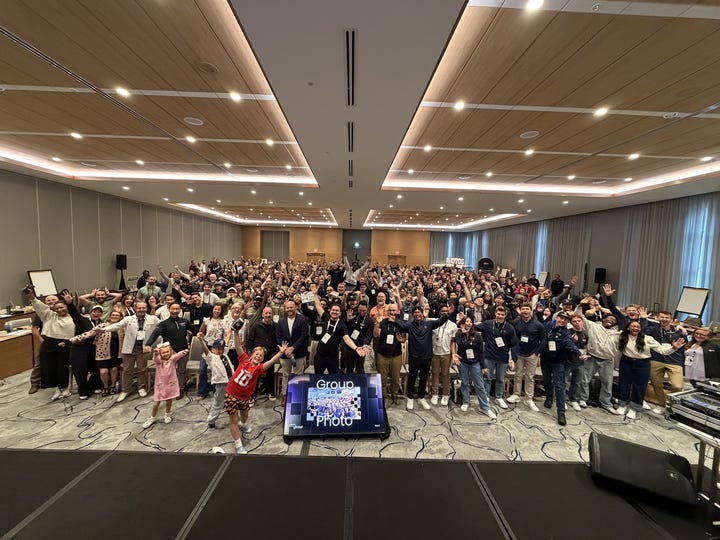
Looking down from the stage last week, we were so excited about the diversity and the passion that was in the room. It’s hard to believe that the first hackathon was just two years ago in a refurbished hangar, and now in 2025, we’re seeing a true ecosystem emerge: developers collaborating across continents, churches experimenting with AI discipleship tools, and Christian technologists shaping public conversations about ethics and trust.
This year, nearly 700 innovators converged online and in Boulder, Colorado, for the third annual Gloo AI Hackathon. Over three whirlwind days, coders, pastors, gamers, theologians, and designers stretched the limits of creativity around a simple theme: AI that drives human flourishing.
And flourish we did. 98 teams worked on ideas that reimagined how technology could serve the Church and the greater good. From Bible translation tools and immersive gaming experiences to applications that measure spiritual openness, the ideas were as audacious as they were faithful. After a late-night preliminary round, 34 finalists were selected. The next day, $250,000 in prizes were awarded to those whose innovations showed the most promise for values-aligned technology.
This year’s Grand Prize winner, Veritas from Austin Christian University, captured that vision perfectly, an immersive Bible app designed to help people not just read Scripture but live it.
Prizes were awarded across additional categories, including:
Best of Hacking Track – Kommonwealth from kommon.ai
Best of Gaming Track – Cede from BareHand
Best of Vibe Coding Track – Flora from Biola University
Best of Gloo Track – TheoBox from XRI Global
Best Technology – Church Search Engine from Pastors AI
Best Design – Adventure Awaits: Family Road Trip from So Peculiar
Best Storytelling – Spiritual Openness Score from Apologist Project
Best Concept – faith.tools AI Kit from faith.tools x Lightworks
International Prize – Trellis from Australia
Bible Translation Prize – Glossbot from Glossbot
Hackers’ Choice 1 – Ephphatha from Biola University
Hackers’ Choice 2 – Ripples from Clear Creek Community Church
The work doesn’t stop with the hackathon, either. Many teams will continue to develop their work in their home organizations. All projects have the opportunity to apply for the Faith and AI Cohort hosted by Missional Labs. This 12-week early-stage accelerator cohort for ventures on the frontiers of faith and AI invites builders to grow and launch their work alongside leading mentors, partners, and peers.
The AI Working Group and FaithTech Workshop: Building the Future Together
Running alongside the hackathon was the AI Working Group, a half-day session that felt like the theological lab to the hackathon’s creative garage. Leaders from YouVersion, Biola University, RightNow Media, and others gathered to tackle questions that cut to the heart of AI and faith: What makes an LLM biblically trustworthy? How do we ensure safety, theological integrity, and human dignity in digital discipleship?
Out of the conversation came early drafts of what participants called a “constitution” for biblical AI, a shared framework to guide ethical development. The group identified three non-negotiables: personal safety, biblical accuracy, and theological alignment. They debated margins of error in Scripture references, discussed how trust is built (and lost) in digital spaces, and began sketching principles that could shape the future of values-aligned AI.
FaithTech led another pre-event workshop on building technology redemptively, gathering people from across the ecosystem to train in their 4-D cycle, a way of building technology that redemptively changes the world while transforming those who build it.
It was part philosophy, part engineering, part team retreat and entirely kingdom-minded.
A Movement, Not Just a Moment
As our CEO Scott Beck put it, “Technology should not only be powerful, it should be redemptive.” The hackathon proved once again that when innovators rally around that belief, the Church doesn’t just keep up with the future, it helps write it.
Here’s to the next line of code, the next team of dreamers, and the next chapter in building AI that helps people and the world flourish.
Learn More!
Read our feature in Church Leaders here.
Last Updated
Register for the 2026 Gloo AI Hackathon
Share on:
Author(s)
Ali Llewellyn
Senior Manager, Gloo AI
Nick Skytland
VP, Gloo Developers


