Gen Z Is Going to Church More Often. Thousands of Churches Are Leveraging AI to Meet the Moment.
4 min
Gloo News


Young churchgoers are attending more frequently than they have in years. At the same time, participation in one of the country's largest church invitation movements has nearly doubled. This September, thousands of churches are adding AI to the outreach process, not to replace pastors, but to give them more time with people.
Something unexpected is happening in American churches: Young adults who go to church are showing up more often.
Research earlier this year from Barna Group and Gloo's State of the Church finds that Gen Z churchgoers now attend church nearly twice a month, more frequently than any other generation and nearly twice as often as they did five years ago. Millennials are following a similar trend.
The findings do not mean every Gen Zer is suddenly returning to church. But among young adults who already attend, something has clearly changed: They're showing up more often.
At the same time, one of the country's largest coordinated church invitation movements is experiencing growth of its own.
Back to Church Sunday returns September 20, bringing churches across the country together around a simple idea: invite someone to church.
More churches are joining that effort. From 2022 to 2025, participation in Back to Church Sunday nearly doubled, growing from about 3,500 churches to over 7,000.
Year | Total Submissions | YoY Growth |
|---|---|---|
2022 | 3,878 | — |
2023 | 2,836 | -26.9% |
2024 | 4,939 | +74.2% |
2025 | 7,827 | +58.5% |
2026 (YTD) | 3,166 | In Progress |
The two trends are not necessarily connected. But together, they create an interesting backdrop for what thousands of churches are preparing to do this fall.
As Back to Church Sunday enters its 17th year, the movement is adding something that barely existed when it began: AI.
A 17-Year-Old Movement Meets AI
The idea behind Back to Church Sunday is remarkably simple.
One person invites another person to church.
What happens around that invitation is not always so simple.
Churches want to reach people in their communities, often through websites, content and digital outreach. Then they need to answer questions, collect contact information, follow up and help visitors stay connected beyond their first Sunday.
At a large church, those responsibilities may be spread across communications, marketing and ministry teams.
At a smaller church, the same pastor meeting a new family on Sunday may also be the person writing the email, updating the website and making sure someone follows up on Monday.
That is some of the work Outreach believes AI can take off pastors’ plates.
Outreach ONE is designed to bring more of that work together in one place, helping churches reach new visitors, collect contact information, follow up quickly and build relationships beyond a first visit.
AI can help with work like website and content creation, while automated workflows can help make sure someone who expresses interest actually hears from the church.
The idea behind the technology is counterintuitive:
Use more AI so pastors can spend more time with people.
The goal is not to replace the pastor. It is to give technology more of the process work that consumes pastors' time.
AI Does the Workflow. Pastors Meet the People.
Pastors are not waiting for AI to arrive. Many are already using it.
Recent Barna research finds pastors are turning to AI for brainstorming, communications, research and other everyday work, even as they continue to wrestle with where the technology does and does not belong in ministry.
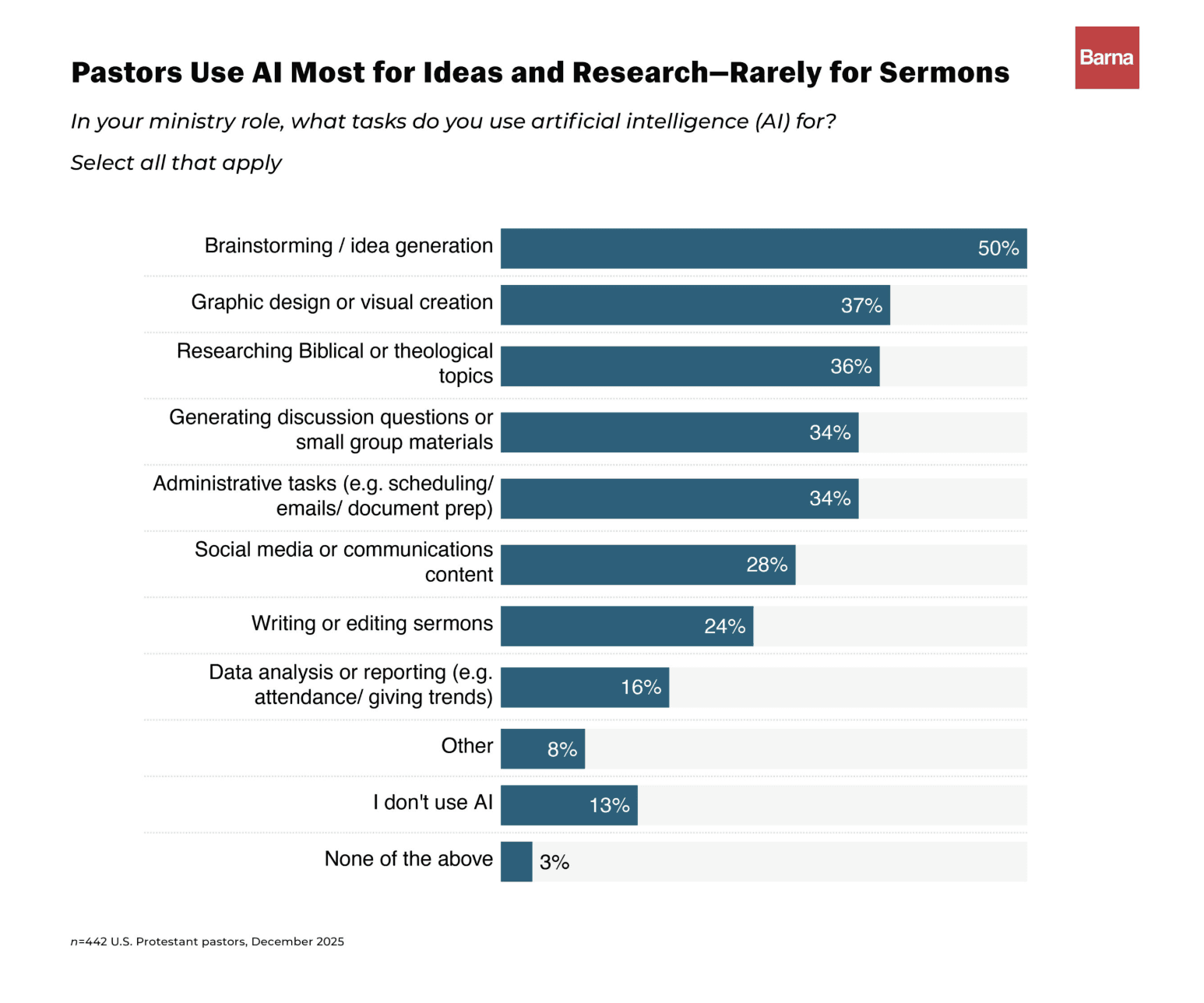
That tension is important.
The question is not simply whether churches will use AI. Many already are.
The more interesting question is what they will ask it to do.
Back to Church Sunday points to one possible answer: Let AI handle the tasks that do not require a pastor to be a pastor.
It can build the webpage.
It can help create the content.
It can connect the workflow.
It can help make sure someone who raises their hand does not disappear into an inbox.
Then, when that person walks through the church doors, the technology can move into the background.
The pastor can have the conversation.
The volunteer can learn someone's name.
The visitor can become more than a data point.
This Isn't a Story About Every Gen Zer Returning to Church
The Barna findings do not mean every young American is suddenly returning to church. Overall attendance remains relatively stable.
What has changed is how often younger churchgoers are showing up.
Among Gen Z churchgoers, average monthly church attendance has nearly doubled since 2020. Millennials have followed a similar trajectory.
That means the generational pattern inside America's churches has shifted. Younger churchgoers are now attending more frequently than older generations.
Separately, churches are increasingly mobilizing around outreach.
From 2022 to 2025, the number of churches participating in Back to Church Sunday nearly doubled–from 3,483 to 6,911–with 2026 numbers still incoming.
The movement also reaches well beyond one region. Texas leads in cumulative church registrations, followed by California, Florida, North Carolina and Ohio. Pennsylvania, New York, Virginia, Georgia and Illinois round out the top 10.
The significance is not that one trend explains the other.
It is that both are happening at a moment when churches are thinking seriously about what it takes to move someone from an invitation to an actual relationship.
So What’s Next?
The real test for churches will not be how many people show up on September 20.
It is what happens next.
Does someone know they're new?
Does someone remember their name?
Does someone follow up on Monday?
Does a first visit become a second?
That is where the combination of a 17-year-old invitation movement and new technology becomes particularly interesting.
The goal is not simply to use AI to reach more people.
It is to remove some of the friction between reaching someone and actually knowing them.
On September 20, thousands of churches will participate in a movement built around an idea that has changed very little in 17 years:
Someone invites someone else to church.
Technology can make what happens around that invitation faster and easier. It can build the page, send the follow-up, and keep someone from slipping through the cracks.
But it cannot replace what happens when someone walks through the door.
That may be the more interesting lesson as organizations everywhere wrestle with what AI should and should not do.
In this case, the technology is not being asked to replace the relationship.
It is being asked to clear more room for it.
Let AI handle more of the process so pastors have more time for people.
Get involved in the Back to Church Sunday movement
Share on:
Continue Reading

‘We’re Doing This for the Lord’—Biola University Students Reflect on Gloo’s 2026 AI Hackathon

‘Fight Like Jack’—At Gloo’s 2026 AI Hackathon, Austin Christian University Students Win $100K on Behalf of Injured Classmate

Gloo AI Hackathon Winners Announced, Showing What Applied AI Can Do for Human Flourishing

One in Three Young Adults Says They’re Going to Church More Than a Year Ago